
Tone and color
Faded photo restoration in New York
Sun from a window, warmth from an apartment radiator, and the slow chemistry of older papers all pull the life out of a print. Faded photo restoration at Next Photo I.V.A works with the density that is still there: contrast, remaining color, and the difference between a face and the wall behind it.
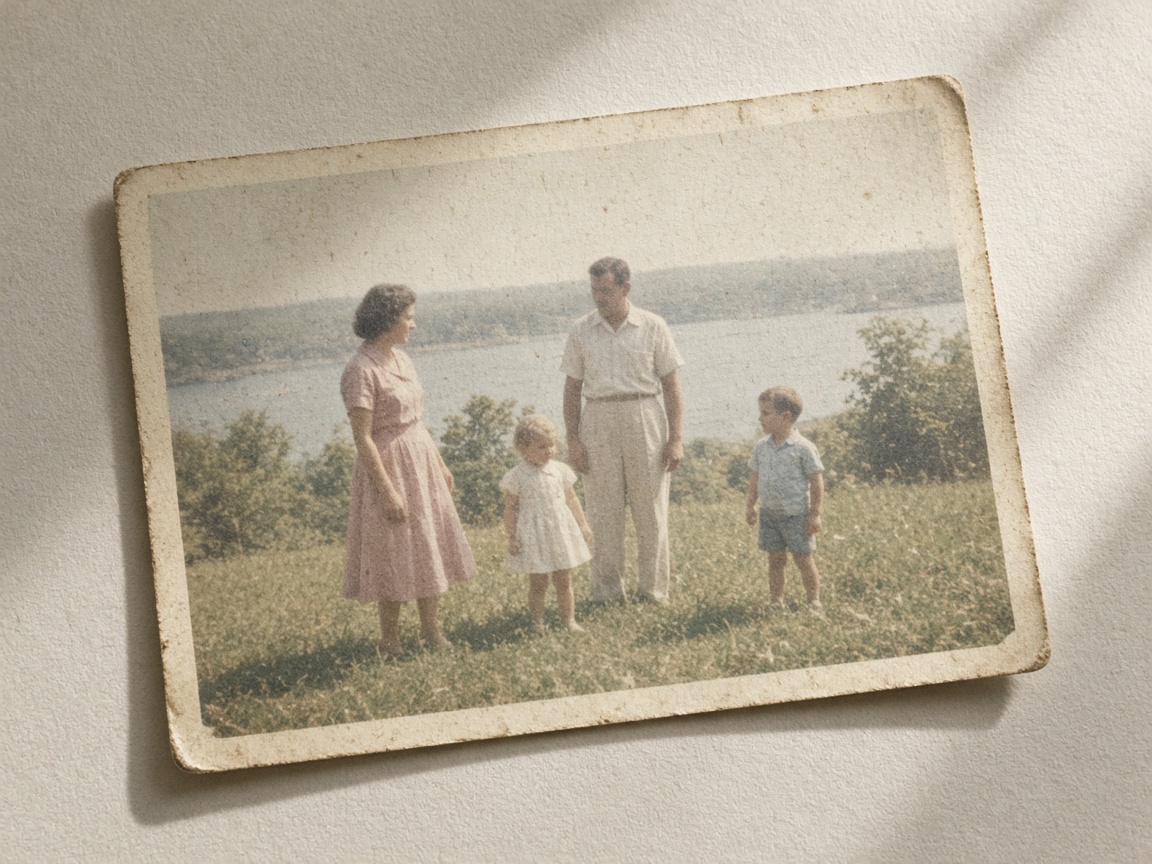
How fading usually appears
Some photographs lighten evenly. Others fade first at the edges of a frame or along the side that faced the light. Color prints from the later twentieth century often shift toward yellow or magenta while the cyan dyes weaken. Black-and-white prints may go brown, pale, or low in the shadows.
- Loss of contrast between subject and background
- Yellowing of highlights and paper base
- Color casts that sit over skin, clothing, and sky
- Weak detail in dresses, trees, and distant buildings
- Uneven fading from albums, windows, or partial covers
What can often be improved
If silver or dye is still present, even faintly, contrast can often be brought back into a readable range. A heavy yellow veil can sometimes be reduced so faces separate from the paper. Color that has drifted can be steadied toward a more natural balance without pretending the print was shot yesterday.
Black-and-white photographs are restored in grayscale unless you ask for colorization as a separate, interpretive step.
When fading has gone too far
A print that is almost blank holds almost nothing to restore. Pushing contrast on empty paper creates noise and false texture, not a recovered scene. Restoration stays inside what the source still contains.
How the work proceeds
Your request should mention whether the photograph is color or black and white, and whether the fade is even or patchy. After review, work is done on a digital copy. The restored image is delivered as a digital file.
Questions about faded photographs
Can faded colors be improved?
Often, when dye still remains in the print. Colors that have vanished entirely cannot be recovered from the photograph itself; they would have to be guessed.
Will the photograph look new?
The aim is a clearer, more balanced version of the same image. Age, grain, and the original lighting remain part of the picture.
Does yellowing always come out?
Yellowing can often be reduced. On some papers it is mixed into the image in a way that cannot be separated completely from the photograph.
Send a faded photograph for review
Note whether the print is color or black and white, and whether the fade is even or stronger in some areas.